1. Living With Jakarta’s Floods: Nights in the North

This entry is part 2 of 4 in the series A Dive into Sinking Jakarta

Introduction

Jakarta does not drown all at once. It rises slowly around your ankles, then your knees. It comes not as a siren-blaring emergency, but as a nightly rhythm. For residents like Mr. Adoel and Mr. Roedi in North Jakarta, the flood is not a surprise. It is the water they live in.

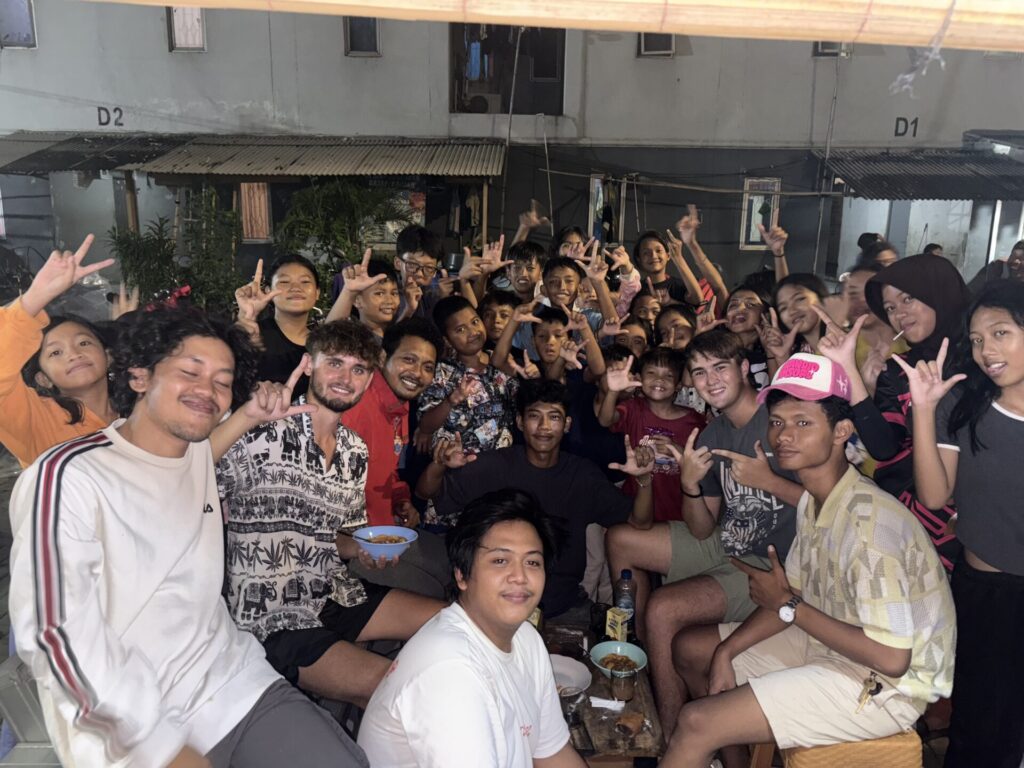
Its 9 p.m. on a humid evening, I arrived with two local guides, Jarr and Aps, into a flood-prone neighbourhood in North Jakarta. We had stopped first at a local shop to buy cigarettes for Mr. Adoel and snacks for his daughter. He greeted us warmly. Within minutes, a crowd of children formed around us, curious and energetic. They giggled, stared, and whispered.

“Floods every evening,” Mr. Adoel told me with a grin that barely masked the fatigue. Sometimes the water rises to his chest. He lives upstairs now. When asked what he does when it’s too deep to leave the house, he shrugged and joked, “Even if the flooding goes up to your chest, you can still play football.”

Life in Perpetual Water

What struck me first wasn’t just the water, but the adaptation. Homes are adjusted, routines shifted, resilience normalized. Mr. Adoel described how they continually raise their houses higher each year as the land sinks further—by an estimated 23 centimeters annually.

The government has made some efforts. In this area, several stilt houses and even floating structures have been built to replace those lost to prior floods. But for many, such help comes only after destruction.

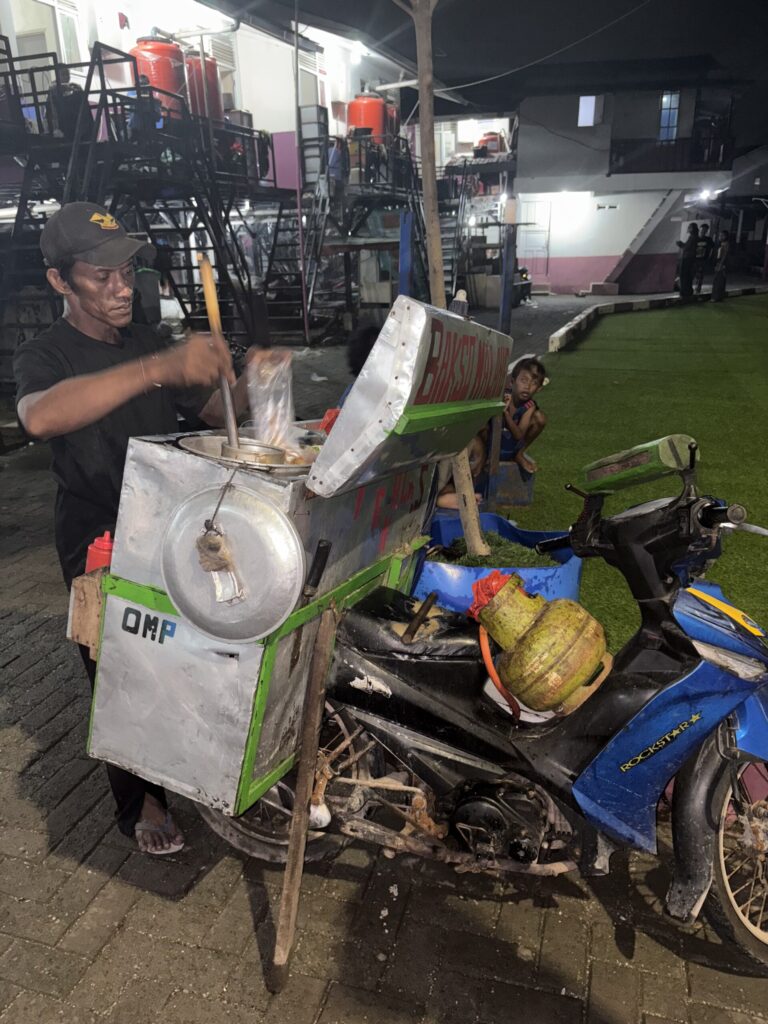
Mr. Roedi, age 28, lives in one of these government-provided stilt homes. He sells meatballs from a motorbike kitchen to support his wife and child, earning around 2 million IDR a month (about USD $125). “Alhamdulillah, I am blessed,” he says. “If we are still able to survive, then I want to stay here. If I am not able to sleep here, then I will have to move.”

There is no insurance. The original houses were handmade—bamboo, plastic, corrugated tin. When the sea rises, they vanish. No payout. Just hope that the government notices.

Data check

Disclaimer: Image is not of Mr. Roedi

Walkways of Shells, Pools Beneath Homes

Flood management in these communities takes unusual shapes. In one neighbourhood called Rumah Panggung, we walked on a path made not of stone or mud but millions of mussel shells. It was only when Jarr pointed it out that I realised I hadn’t been walking on ground at all.

Nearby, a small concrete pool sits beneath a stilt house. It’s filled with water that, unlike the sea, is deemed “clean” enough for children to swim in. The owner charges 5,000 IDR (30 US cents) for unlimited use.

“A lot of kids swim in the sea,” Jarr explained, “but there’s bacteria. So here, they pay to swim for over six hours.”

A few streets over, we reach a row of floating houses—fixed in place but designed to rise and fall with the tide. The floating walkway bounces underfoot. These structures are part of a pilot housing initiative from the government, targeted at residents whose homes were previously lost. The concept: if the city is sinking, make homes that float.

Writing on the Wall

Jakarta is one of the fastest-sinking cities in the world. The North is the worst-affected, its subsidence driven by a mix of groundwater extraction, rising seas, and urban overload. Approximately 40% of Jakarta now lies below sea level, with projections indicating that up to 95% of North Jakarta could be submerged by 2050 if current trends continue.

Jarr and others spoke about the government’s long-promised sea wall—a vast coastal barrier that might delay the city’s collapse. Japan and the Netherlands are among the partners involved in this US $40 billion project. But locals remain sceptical. Construction is slow, communication unclear.

“They are trying to build it as fast as possible,” Jarr said. “Some parts might take a year. Maybe seven years in total. But even then—who will it protect?”

Indeed, the wall is being planned to protect high-value zones: northern skyscrapers, elite housing, and the ports. It’s unclear if informal settlements like these will benefit directly.

A Rising Reminder

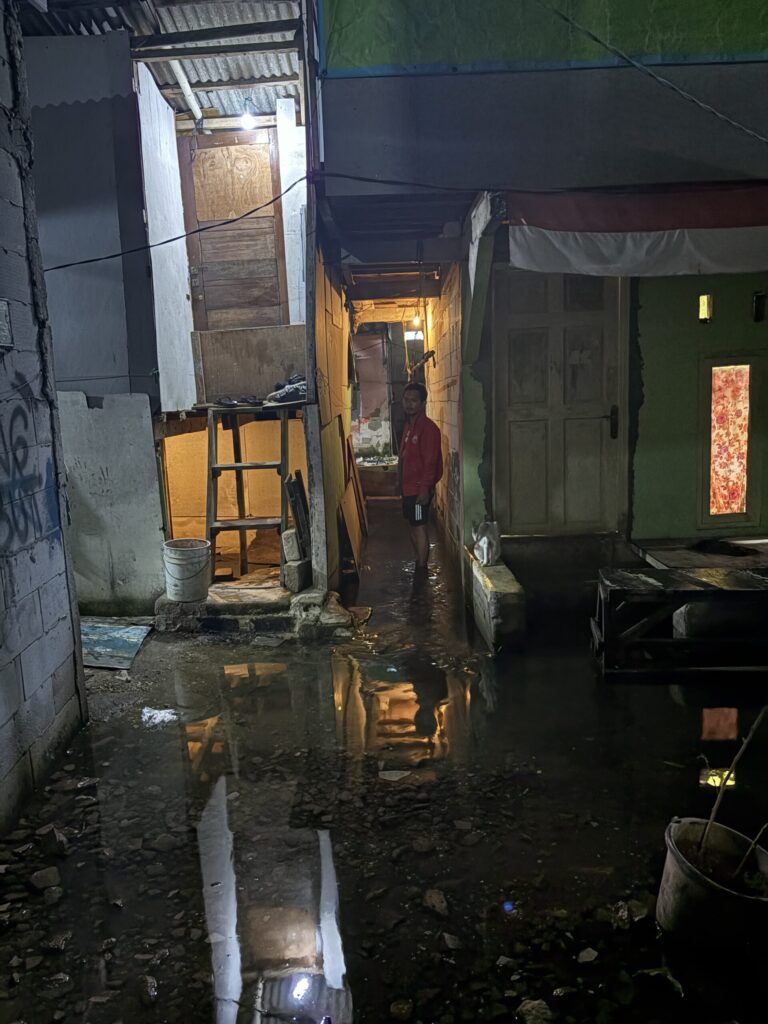
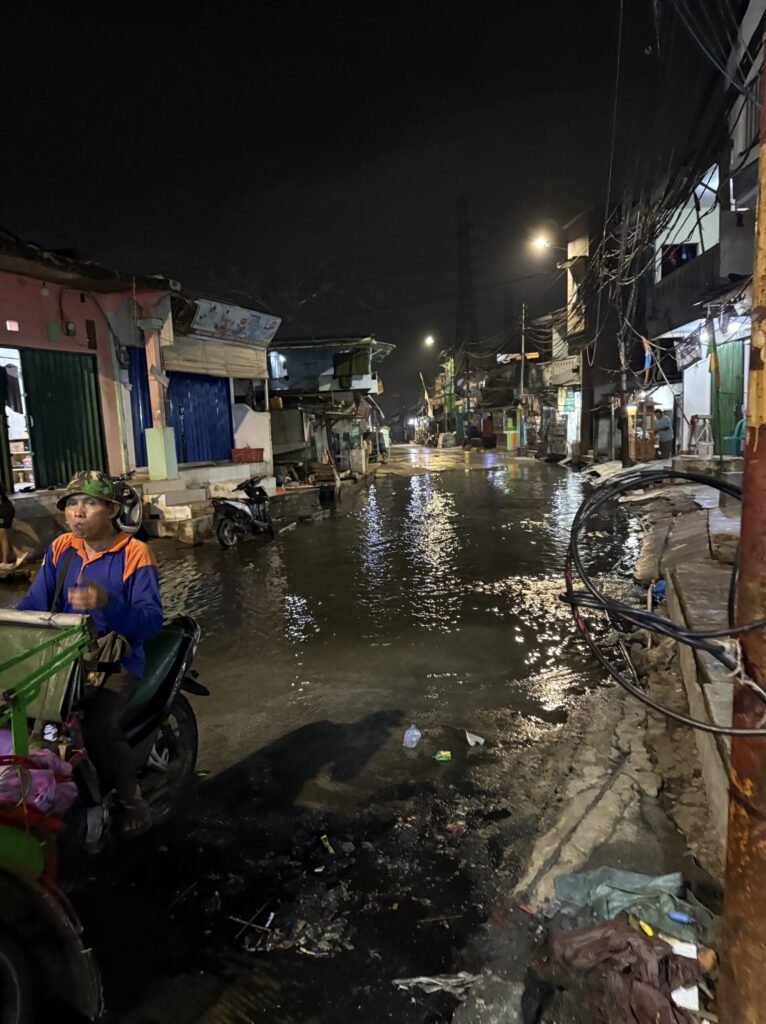
On the morning of June 23rd 2025, a video sent to me by Jarr from Mr. Adoel showed something startling: the same street we had walked down together, last night submerged in waist-deep floodwater. Children were swimming and playing where we’d stood only weeks earlier. I opened one of my photos from that night — same angle, same buildings, completely different reality.

There hadn’t been any heavy rain. I checked with Jarr to make sense of it. Turns out this kind of flooding isn’t triggered by rainfall at all. It’s the tide — or more precisely, a tidal surge caused by strong winds and lunar cycles, pushing seawater up into the northern edge of the city. This phenomenon, known locally as banjir rob, can happen completely independent of storms.

I asked the obvious: what happens to the motorbikes, all the vehicles and belongings that line these streets? Jarr explained that the water doesn’t come in all at once. It builds slowly, hour by hour, giving people time to move what they can to higher ground or stash bikes in less flood-prone parts of the neighbourhood. It’s not chaos — it’s routine. The flood comes at night and usually clears by morning.

This one, Jarr told me, might last two more nights. Locals expect the peak tonight. Then the cycle begins again.

Jarr was blunt, as always: “This is why the sea wall has to be finished — and fast.”

Before
After

No Exit Plan

I asked Mr. Adoel if he had a plan B. “People really want to move,” he said, “but they don’t have anything. No money, no options.”

In this part of the city, children walk to school with their trousers rolled high or paddle to class in government-supplied boats during the rainy season (October to March). One schoolchild laughed and told me, “If it’s the usual flooding, we just pull our trousers up and walk.” Access roads become rivers. Yet, life goes on. Meatballs are sold. Songs are sung. Football is played on floating pitches.

Mr. Roedi summarized the contradiction: hope wrapped around hardship. “If the new capital is nice, I would love to move. But if it gets worse, I want to stay here.”

For now, his house stands elevated on stilts—and so does his hope.

For investors valuing Jakarta real‑estate yields, every centimetre of subsidence widens the risk premium—a theme we’ll unpack in Part 5.

[END PART 1]

Next: How local governance, not central planning, keeps Jakarta’s streets running.

Jarr photo 2

During my recent visit to Jakarta, I had the amazing opportunity to explore the city’s authentic side with @explorewithjarrr on Instagram. They offer an incredible walking tour that not only shows you the hidden gems of Jakarta but also provides insights into local culture and history. Whether you’re looking for a free walking tour with tips or a private tour tailored for your group, Jarrr and their team have got you covered. They’re passionate about sharing Jakarta’s most genuine experiences and are open to collaborating with creators from around the world. If you’re planning a trip to Jakarta and want to document the city’s true essence, I highly recommend reaching out to ‘Explore with Jarrr.’ You won’t be disappointed! 

WhatsApp number: +62 896-4927-9933   Instagram: @explorewithjarrr

Please Note: The stories and communities featured in this six-part series are not part of the walking tour experience offered by Explore with Jarrr. This fieldwork was conducted independently with full consent and outside the scope of any public tour.

A Dive into Sinking Jakarta

README 2. Neighbourhood Governance in Jakarta: How ‘Kerja Bakti’ Keeps Streets Running